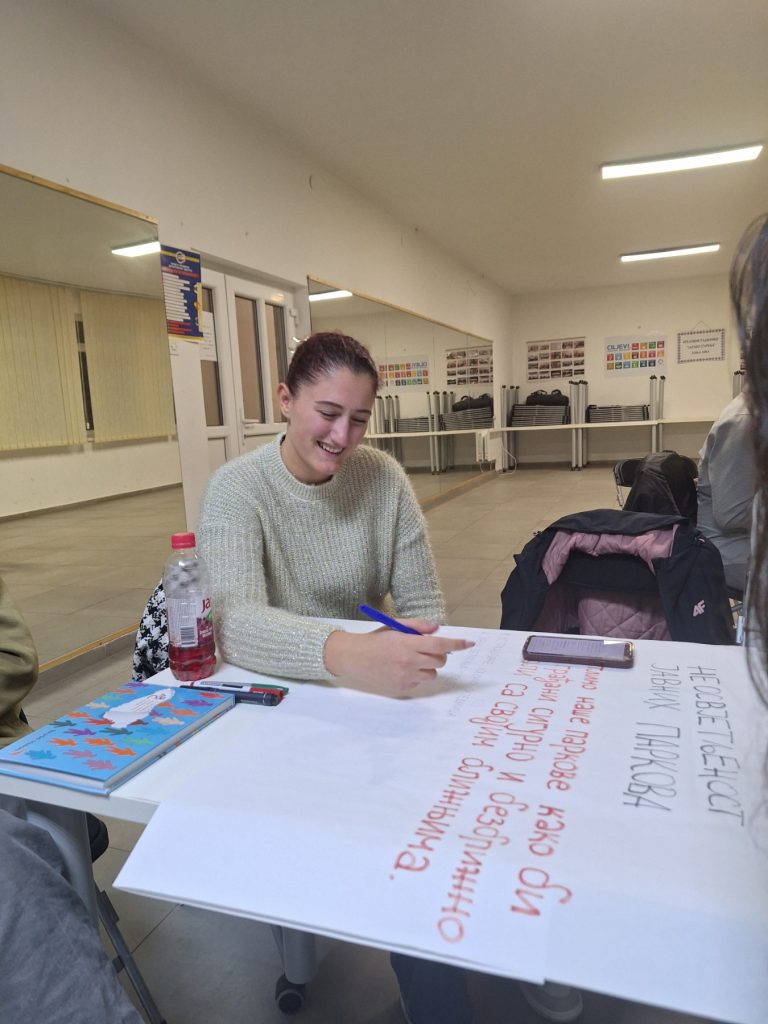
Workshops titled “Consultations on the EU Integration Process and Accession Priorities of Bosnia and Herzegovina with Children and Youth”, focused on the 14 key priorities that BiH must meet to advance in the EU integration process, were held with the participation of 40 young people from various parts of the country, including both rural and urban areas.
Participants discussed the main challenges hindering the integration process and emphasized the importance of meaningful participation of children and youth in these efforts, as well as how they can contribute through various initiatives and programs.
To ensure that participants understood the information presented, a quiz was organized with questions on the basics of the EU, BiH, and the integration process. At the end of the workshop, participants had the opportunity to retake the quiz to compare their knowledge before and after the session.

Based on what they learned, representatives of the mentioned organizations identified two key topics—“How to support the most vulnerable peers” and “Cyberbullying/abuse of children and youth”—on which they will conduct research and develop initiatives and advocacy campaigns within their local communities.Examples of poor cooperation between local authorities and children and youth on these two issues were identified, along with potential solutions offered by the EU Youth Strategy. Participants were encouraged to link the core elements of this strategy to the specific problems they aim to address in their communities when designing their activities and projects.
The conclusions are as follows:
- Cyberbullying is not adequately addressed in society as a relevant and significant challenge.
- Young people are unfamiliar with protection mechanisms, both at the local level and those available through potential EU membership.
- It is necessary to strengthen the capacities of children and youth to recognize false information and distinguish clearly between truth and lies in the digital world.
- Experiences with local authorities, such as the police, show that existing protection mechanisms, although acknowledged, do not provide sufficient support to children and youth when reporting cyberbullying.
- Vulnerable groups are often invisible: there is no clear understanding of what it means to be a vulnerable child or young person.
- There is a gap in opportunities available to children and youth in urban versus rural areas.
- Children and youth with disabilities or developmental difficulties have talents that are hidden and need to be supported; they should be approached with the mindset: “Everyone has a talent.”
Recommendations:
- Include parents in the educational process about the dangers of the virtual world.
- Establish partnerships with social work centers through the development of educational programs.
- Collaborate with local community councils, as they engage with local residents directly.
- Ensure continuity in capacity-building efforts, especially through long-term education and the development of projects focused on the inclusion of vulnerable categories of children and youth.
- Focus on creativity as a tool to help integrate vulnerable children and youth into society.
- Analyze local regulations and identify opportunities for collaboration at the local level, as well as advocate for changes in areas where current policies do not support the empowerment of vulnerable groups of children and youth.